Wednesday, August 28, 2013

Teaching About the March on Washington for Jobs and Freedom: 50 Years Later

Today marks the fiftieth anniversary of the March on Washington. During the rally afterward, Martin Luther King delivered his "I Have a Dream" speech (click below). It is probably the most well known American speech and it is often played yearly in many U.S. history classrooms around the nation during their civil rights movement units.


I am a social studies education professor at Martin Luther King's alma mater, Boston University (where he became "Dr." Martin Luther King), and while he was studying here, he lived in my neighborhood of Dorchester. The closeness of his early history creates a special place in my heart for him and his work. However, when I reflected on this important date, I decided to write about what is commonly not known about the 1963 March on Washington. In many ways, it is the stories of the other people involved in the rally and march. As social studies teachers, it is crucial that we are teaching the full story and examining this moment in history at a deeper level then it usually receives. How can we help our students see that this day represented not just one person's speech, but a grassroots movement of thousands of people working for equality and justice?


Here are some things you may want to teach about the March on Washington:

1. It was the March on Washington for Jobs and Freedom. Often the last part of the title gets dropped. One of the main themes of the civil rights movement in general, and Martin Luther King's work in the 1960s, in particular, was economic justice. In fact, when MLK was assassinated in 1968, he was in Memphis to support and rally striking sanitation workers fighting for fair pay.

2. The march was originally planned over 20 years earlier. A. Philip Randolph, with his colleague Bayard Rustin, first called for a march on Washington in the 1940s to illuminate discriminatory hiring practices in the war industry. However, 1963 seems an appropriate year to finally achieve their vision; it was the 100th anniversary of the Emancipation Proclamation and a time when there was pending civil rights legislation stalled on Capitol Hill.

3. Martin Luther King gave a very similar speech to "I Have a Dream" in Detroit in the months beforehand. Tying into themes of poverty and social inequality, there were, however, some different lines, such as "I have a dream this afternoon, that one day, right here in Detroit," King said, "Negroes will be able to buy a house or rent a house anywhere that their money will carry them, and they will be able to get a job."

4. Unions played a major role in supporting the march. Although the AFL-CIO did not endorse the march and the reality is that many labor unions restricted Black membership, unions (especially those organized and led by Black workers or did not use race to restrict membership) supported the rally and the greater movement for racial equality. Also, often forgotten, are the many unions that organized, transported, and supported marchers.

5. There was a radical history behind the rally, which has been suppressed in the popular media. This was particularly strong among the students at the rally. John Lewis, one of the founders of the Student Nonviolent Coordinating Committee was asked to remove segments of his speech that were critical of the Kennedy administration and many other student speakers (and their supporters) wanted to be more critical and aggressive in their rhetoric. The organizers of the rally, A. Philip Randolph and Bayard Rustin, were both pacifists and socialists. They did not focus on only stopping racism, but stopping all forms of oppression, including their work for economic justice. They were both motivated by the work of W.E.B. Du Bois (a radical of his time), particularly his book, "The Souls of Black Folk." Furthermore, Bayard Rustin was gay and out, which not only was progressive for the time, but it also risked his personal freedom (he was jailed for homosexuality in 1953), as well as his safety and well-being (as anti-gay violence was quite prevalent). He would later become a vocal advocate for gay rights.


The media estimated that over 200,000 people attended the march and rally; organizers believed it was closer to a million. Regardless of the numbers, the March on Washington for Jobs and Freedom raised the profile of the movement. Many historians believe it helped motivate some politicians to change their position on civil rights issues, ultimately leading the the Civil Rights Act of 1964 and the Voting Rights Act of 1965. However, Martin Luther King and the movement's mission did not end in the 1960s. Civil rights organizations like the National Association for the Advancement of Colored People, National Council of La Raza, Japanese American Citizens League, Organization of Chinese Americans, Native American Rights Fund, American-Arab Anti-Discrimination Committee, Gay and Lesbian Alliance Against Defamation, and the National Organization for Women continue much of this work. Racism and discrimination is certainly still with us. From the recent Supreme Court decision gutting a major provision of the Voting Rights Act to the killing of Trayvon Martin, race is still one of the main dividing factors in the United States. More than 60 years after Brown v. Board of Education, school segregation is increasing and the employment gap between Blacks and Whites persists. If we are to truly begin to achieve MLK and the movement's dream, we must confront the embedded racism, calls for colorblindness, and evident link between Whiteness and power. 

When I was a high school social studies teacher in Framingham, Massachusetts, Mark Kissling was a close colleague. Like myself, he is now a professor of social studies education (at Penn State) and he wrote this thought-provoking editorial reflecting on today's anniversary. He asks, what would MLK say today about civil rights and the movement. He links his argument to Cornell West's recent profound reflection that, "Brother Martin would not be invited to the very march in his name, because he would talk about drones. He’d talk about Wall Street criminality." I would add that MLK would most likely focus his arguments and speeches on poverty and our nation's persistent oppression and injustice. Let's not let his voice, and especially the voice of the movement, fade.


Read more here: http://www.centredaily.com/2013/08/28/3758700/reflections-on-kings-dream-50.html#storylink=cI encourage you to read it.

Wednesday, August 21, 2013

Learning from Singapore: Part 2


My first visit in Singapore was to the Academy of Singapore Teachers (AST), where I met with history Master Teacher Andrew Anthony. Unlike the U.S., Singapore has decided to increase their focus on inservice professional development. In 2010, AST was established by the Singapore Ministry of Education (MOE) to be the backbone of that effort. It is currently housed in a former high school building, but one day it will be relocated to the Ministry of Education. The purpose of AST is to coordinate the professional development of teachers and offer enriching inservice courses. My wife (a science educator) and I were able to sit in on course for elementary teachers on students' alternative conceptions of science (which in many ways paralleled the work being done by the Science Department in the Boston Public Schools). In our conversation, Andrew explained to me that in Singapore, a teacher is never prevented from attending professional development by their principals and their principals are always given adequate support with substitutes. Teachers are entitled to at least 100 hours (during the work day) of professional development a year. This includes a mix of full-day and half-day PD sessions. Teachers are also encouraged to attend PD outside of the MOE, as well as attend and present at international conferences.

Another goal of the Academy of Singapore Teachers is to help teachers integrate the curriculum (which they refer to as syllabi) into the teachers' classrooms and support reflective practice. In 2001, Singapore revised its history syllabus and associated assessment to focus more on inquiry-based history. To be honest, what I heard from several Singaporean sources is that while the syllabus and assessment changed, much of the teaching has not. Although more teachers in Singapore are using more primary sources because the assessment requires it through a document-based question, many are still not having their students engage in inquiry in the classroom. While many of the newer teachers and some of the more open-minded experienced teachers have embraced the change, AST is part of that puzzle to help Singapore's history teachers truly start to integrate inquiry-based learning in their classrooms.

Singapore's has chosen to have a strong focus on pedagogy as a means for improving their education system. Over the past two decades many education reformers in the U.S. have focused heavily on content knowledge (which was essentially the focus of Singaporean education in the 1980s and 1990s) and lambasted schools of education for their practices around teaching pedagogy. However, it was clear from my visit to AST (as well as other segments of the education system in Singapore) that they do not want teachers to only think about content, but more importantly, how to teach that content to their students.

While the U.S. continues to marginalize history and the other disciplines in social studies, it appears that Singapore has decided to increase social studies education. They have separated history, geography, and social studies into separate subjects, and increase their teaching of civics. While the Common Core in the U.S. only includes social studies standards related to literacy and only for grades 6-12, Singapore's elementary social studies curriculum is extensive.

Finally, an interesting idea that the U.S. should consider adopting from Singapore, perhaps at the state level, is subject chapters and meaningful career ladder options for teachers. To support inservice teachers, AST has created subject chapters, where teachers can collaborate or share ideas through a professional fraternity. Andrew Anthony is the head of the History Chapter. Although the U.S. has many professional organizations (i.e. NCSS, MCSS), a government-sponsored organization that allows for teachers to share their ideas and collaborate on a regular basis seems to offer a real innovation in professional development. Beyond the subject chapters, Singapore has created three tracks fir advancement (teaching, leadership, and senior specialist) and in the "teaching track" there are four levels of advancement (see below). The teaching track allows teachers a career ladder, while helping keeping them in the classroom. Although this track is relatively new, it allows some teachers to work as master teachers (such as Andrew Anthony) or principal master teachers, where others may become senior or lead teachers, all supporting other teachers.


Thursday, July 25, 2013

Learning from Singapore: Part 1


Singapore is one of the highest-performing nations on international standardized tests. In fact, it is one of the few countries that out-performs Massachusetts on the Trends in International Mathematics and Science Study (TIMMS). However, Singapore is also concerned that their education system has an over-emphasis on standardized testing and not enough development of creativity and critical thinking (something many experts in Singapore argue the U.S. does better). To address this, the Singapore Ministry of Education has pushed for a more "student-centric" education system. They have encouraged their teachers to "teach less," so that students might "learn more." However, the story is quite different in the United States, which continues to increase its emphasis on standardized testing. As a result, there is more emphasis on math, science, and literacy, at the expense of social studies, world languages, art, and other subjects. Meanwhile, Singapore has not only continued to support a robust history education curriculum for its students, but it has increased emphasis on civics education.

In an attempt to exchange ideas with Singaporean teachers and teacher educators, I will soon be traveling there to learn first-hand about their education system. I will be meeting with Ministry of Education officials, master teachers, and social studies education professors at the National Institute of Education to gain a better understanding of their social studies curriculum and teaching practices. I hope to focus on their views of history education and teacher education. I also hope to share my work in social studies education, teacher education, and my advocacy for teacher research. Over the next month, I will use this blog to reflect on what I am learning as a teacher, teacher educator, and researcher in Singapore.


Tuesday, July 16, 2013

Teaching About Trayvon Martin


Anger. Frustration. Sadness. Disbelief. These are just some of the emotions I felt on Sunday morning when I woke to an NPR story explaining that George Zimmerman was found not guilty on all counts in the Trayvon Martin murder case. The fact that the "Stand Your Ground" law permitted a man to follow and then murder an unarmed teenager seems to be the epitome of injustice. This, of course, was framed by the role of race in our legal system. I continue to ask myself, "If George Zimmerman was Black and Trayvon Martin was White, would the proceedings have reached the same conclusion?" 

The verdict immediately made me think about history. It evoked my memories of 1992 and the Rodney King beating trial and subsequent LA Riots. It reminded me of the group chants I saw on television proclaiming, "Is this America, or South Africa?" It made me think of all those times I have taught about the Emmett Till murder. In both trials, the injustice was as much a problem of individual racism, as it was systematic racism and flawed law (the law in 1955 Mississippi did not allow people of color to serve on juries and the law in 1992 California law favored use of force by police officers). In searching the Internet, I found Ta-Nehisi Coates's poignant discussion of the Trayvon Martin murder case, where he reflects not only the "Stand Your Ground" law, but also the criminalization of the victim, Trayvon Martin, in the media. 

Continuing to reflect on the verdict, I thought about my experiences as someone who lives in a racially and economic diverse place (the Dorchester neighborhood of Boston) and the reality that many of teenagers I routinely pass by in the street or the children of my friends or neighbors could have been Trayvon Martin. As a former high school teacher at a diverse school, Trayvon Martin could have been one of my students. However, many White Americans do not see Trayvon Martin as someone they could have known. They live in places where they have limited chances to meet Black teenagers. With schools becoming increasingly segregated and the racial and economic segregation of our neighborhoods persisting, we have a serious problem with racial division. This racial division allows a Black teenager walking through a White neighborhood to seem suspicious. At a recent Roxbury vigil for Trayvon Martin, one of the speakers raised the point that the protest we were participating in was important, but it would not be until we see vigils for Trayvon Martin in the White communities of the area, in the Wellesley's and the Newton's, that will we know progress is being made.

As teachers, and especially social studies teachers, we must take moments of injustice like these and turn it into opportunities to teach for justice. Whether we teach in a diverse or racially segregated context, we should be having our students examine the Trayvon Martin case, question the current racial and economic segregation of the United States, and analyze the media coverage and state gun laws. We should allow our classrooms to be a place for our students to reflect, but also have constructive conversations on the meaning of the trial and the role of race in U.S. history. We should allow our students to examine the similarities and differences between the Trayvon Martin and Emmett Till murders. We should ask if the reaction to the Rodney King trial verdict and the Trayvon Martin verdict are equally justifiable? If we do this, then then we are beginning the necessary conversations that will help our nation work closer toward racial justice.


Sunday, June 30, 2013

Teaching About Canada's History in the United States History Classroom


Tomorrow Canadians will celebrate their most important national holiday, Canada Day/Fête du Canada, which celebrates the joining of Québec and Ontario with New Brunswick and Nova Scotia creating the federation of Canada. The history of the United States is so closely linked to Canada that it is a travesty that Canadian history is rarely taught as part of a typical U.S. history class. In fact, Americans have very little knowledge of their neighbors to the north. A poll last year in Toronto's National Post found that less than half of Americans can name Canada's capital and very few Americans can name the current Prime Minister.

What events should be discussed in a U.S. history class? First, most Americans do not know that the U.S. invaded Canada at least three times (French and Indian War, War of Independence, and War of 1812). From the French and Indian War (also known in French-speaking Canada as La guerre de la Conquête or The War of Conquest) to genocides committed by New Englanders in Arcadia during the colonial era, Americans have been aggressors toward Canadians before there was even a United States. From being the end of the line of the Underground Railroad to supporting the north during the Civil War and allowing the Lakota Indians led by Sitting Bull to stay in Canada after fleeing from the U.S. government, Canadians have often supported racial justice in the U.S. (in fact, Canada has an incredibly important multicultural provision in their constitution). Finally, the 20th century saw the strengthening of U.S.-Canadian relations as the two countries were allies in World War I and II, and the Korean War, as well as the controversial signing of the North American Free Trade Agreement that was put into effect in 1994 (and to this day has been blamed for massive job losses in both Canada and the U.S.).

Happy birthday Canada, and here is hoping in the next year that Americans learn more about you...


(In case you are American, above is a picture of Ottawa, which is the capital of Canada. It was in part chosen the capital in 1857 because Queen Victoria was advised its distance from the U.S. border could help it be more defensible from a possible U.S. invasion)

Monday, June 24, 2013

The Tale of Two Education Reports


Two national groups hope to influence education with the release this week of their widely publicized education reports. On first glance the two reports seem to have little in common. The first report published by the National Council on Teacher Quality (NCTQ) attempts to rank teacher preparation programs, while the second report published by American Academy of Arts and Sciences (AAAS) examines the teaching of the humanities and social sciences in K-12 schools. Yet, these reports offer book ends of the same debate over the future of our public education system. Whether intentional, both reports speak to major flaws in the the market-based education reform movement's infatuation with education as a means to serve the economy, as well as its obsession with data-driven instruction.


Numerous scholars, including Linda Darling-Hammond, Diane Ravitch, Aaron Pallas, Michael Feuer, Bruce Baker, Mercedes Schneider, Ed Fuller, Jack Hassard, Donald Heller, and the American Association of Colleges for Teacher Education, have highlighted the problems with the recent National Council on Teacher Quality "Teacher Prep Review" report (on the flip side, Secretary of Education Arne Duncan praised it). For those who do not know much about NCTQ, it was created by the conservative Thomas B. Fordham Foundation to directly challenge university-based teacher education. As such, it is not surprising that their report found most university-based teacher preparation programs were inadequate. Its board members include education reformers that favor deprofessionalizing teacher preparation, including Joel Klein and Michelle Rhee. Due to the controversial nature of NCTQ and concerns about data collection, many schools of education (including my own institution, Boston University) refused to provide data. Yet, NCTQ rated many of these teacher preparation programs regardless, and if you look at their report, attempt to publicly shame those institutions that did not share data. 

Despite its research-like appearance, this report is not educational research. The NCTQ report collected syllabi from institutions along with entrance exam scores and used that to rate teacher preparation programs. It is essentially a document reviews without any serious methodology or peer review and based on erroneous or missing data. The report's rating system is primarily based on each teacher preparation program's selectivity and content alignment to the Common Core standards. However, neither variable are an accurate measure of a program's overall quality. The vast majority of critiques of this report can be summed up with Richard Allington's comment, "Imagine a person reviews the restaurants in your city by examining the menus they found on-line. Never tasted the food or ever visited any restaurant." This report assessed teacher preparation programs without ever observing a single course, interviewing a single instructor, or surveying any students. This is not an honest assessment of our nation's teacher preparation programs. Rather, it is a underhanded attempt to undermine the university-based teacher preparation system that has made dramatic improvements over the past two decades. It is indicative of the current state of education reform in the United States.


Meanwhile, the American Academy of Arts and Sciences released their own report titled "The Heart of the Matter." This report was supported by a panel of liberal and conservative politicians and commentators, as well as actors, artists, and media personalities and documented the state of humanities and social sciences in K-12 schools. Although this report was suppose to be earth-shattering, it has been drowned out by the recent uproar caused by the more controversial NCTQ report and a recent scandal involving the resume of the AAAS's director. However, the findings of this report should have received much more media attention. In sum, the report finds that the United States has focused too much educational attention on math and sciences at the expense of the humanities and social sciences. Consequently, the school disciplines that help students develop certain types of creativity, civic knowledge, and understanding of the human experience are being neglected. Meanwhile, other high-performing nations, like Singapore and Finland, are increasing their instruction in the humanities. My main critique of the report is that it suffers from the same obsession with market-based education reform as the NCTQ report. Although not to the same extent, it frames the need for more education in the humanities and social science as an economic imperative. Despite this, the report illuminates the dilemma a nation is put in when it chooses to focus its resources and energy into the school subjects it believes are more important for the economy. It is important to provide a well-rounded education, which includes a diverse array of school subjects.

Thursday, June 20, 2013

Teaching About the Open Door Policy, Boxer Uprising, and U.S. Imperialism


On this date in 1900, the Righteous Harmony Society began a 55-day siege against primarily European powers stationed to protect their economic interests in Beijing. This resulted in the deaths of over 100,000 civilians, 32,000 Chinese Christians, and 200 American and European missionaries stationed in the country. Ultimately, what was referred to by the Chinese as the Yihetuan Movement and the Boxer Rebellion by the Europeans, would be the beginning of the end for the Qing Dynasty. How and why did this happen?

The Boxer uprising took place in a context of a crippled economy and a severe drought in China, but also the growing economic and political influence of outsiders. Only two years after the U.S. won the booty of Puerto Rico, Guam, and the Philippines in the Spanish American War and while the U.S. was still fighting against Filipino rebels, Secretary of State John Hay issued a series of notes describing the United States' position toward China. The Open Door Policy, as it would be labeled, argued that multiple European powers, the United States, and Japan should have open access to trade in China. As these nations began to stake their economic claims, a resistance movement began to gain traction. The Open Door Policy and related Boxer uprising is often dwarfed in U.S. history classes by the Spanish American War and territorialization of Hawaii in the same period, but offer an important case study for students on U.S. imperialism and helps explain the long and contention relationship between China and the United States.

Here are several resources on the Open Door Policy and the Boxer Rebellion, which can be a starting point for teachers in helping students understand the varying historical perspectives of these events.

Resource: https://www.mtholyoke.edu/acad/intrel/opendoor.htm

Resource: http://edsitement.neh.gov/lesson-plan/lesson-4-imperialism-and-open-door

Resource: http://ncta.osu.edu/lessons/china/history/swangerK-ch.pdf

Resource: http://www.gilderlehrman.org/history-by-era/empire-building/essays/open-door-policy-and-boxer-war-us-and-china

Resource: http://www.pbs.org/wgbh/amex/1900/filmmore/reference/interview/lafeber_boxerrebellion.html 

Resource: http://history.state.gov/milestones/1899-1913/HayandChina

Resource: http://www.history.navy.mil/faqs/faq86-1.htm

Friday, June 7, 2013

Teaching About Race and the Last 20 Years of U.S. History


With the election of Barack Obama in 2008, many journalists and commentators declared that the U.S. was now in a post-racial era. This sentiment was echoed by many White students in one of my recent studies that examined students' conceptions of Whiteness in the history classroom. However, racism still persists and can be seen in the educational opportunity gap, the differences in unemployment between racial groups, and the under-representation of people of color in government. Almost 50 years after Martin Luther King gave his famous "I Have a Dream Speech," the United States is far from equal. It is crucial that social studies teachers continue to help students understand and challenge the social and political inequalities that exist in our country. As the end the school year approaches, many teachers are preparing their units on the past 20 years. Any modern U.S. history unit would not be complete without an examination of the intersection of race and history. The following three events could comprise the core of that unit.

Overarching question: Some in the media have suggested that the United States is now post-racial, meaning devoid of racial preference and discrimination. After learning about the following three events, do you agree that recent U.S. history was devoid of racial preference and discrimination?

The Rodney King Beating and the Los Angeles Riots:

Hurricane Katrina:
Katrina's Hidden Race War

NAFTA, Migrant Farm Workers, and Immigration Reform:


Mayoral Forum on Education: Recap


Recently, I expressed my concern that powerful corporate-backed education reform groups and venture-philanthropists are trying to influence both the state legislature and the Boston mayoral race. Along these lines, I highlighted that several of these education reform groups were hosting the first Boston mayoral candidate forum. Adam Gaffin of Universal Hub had an excellent commentary on the debate. As a Boston resident, I also attended the forum to help inform my choice in the upcoming election. After reflecting on the forum, I have grouped the candidates into three camps: market-based reformers, supporters of district schools, and no clear vision. I will summarize the candidates based on these groupings.

Market-Based Reformers:
This camp was entrenched in the market-based reform ideology of the groups hosting the event (Stand for Children, Teach for America, Education Reform Now). These candidates desire more decentralization in the Boston Public Schools. They made clear their support for charter schools, turnaround powers, and outside organizations managing district schools.

John Connolly has been running on an education reform platform since he first declared his candidacy back in February. During the forum, Connolly accused the Boston Teachers Union of being the main barrier to the school district's improvement. I found most troubling his position on taking power away from the central office at Court Street and decentralizing the school district. In his ideal system, each school would function on its own, which he envisions as freeing these schools to be innovative (essentially make the entire district comprised of independent charter schools). This view proves to be incredibly naïve, as it ignores the reality that most charter schools have student populations that are self-selecting and do not represent similar populations to the district schools. For district schools to improve, they actually need centralized leadership and support to guide them in these school improvements.

Dan Conley highlighted his background in the justice system, which ultimately exposed his lack of educational knowledge. It was frustrating listening to him say repetitively "studies show," when it was clear he has limited understanding of educational research. At one point, he declared to the audience that he had no idea why the state hasn't abolished the cap on charter schools, but he could offer very little explanation as to why more charter schools were needed beyond "they get results." Finally, his most concerning comment was that he will treat teacher "training" (his word, not mine) like he trains his attorneys. This shows a fundamental misunderstanding of how quality teachers are prepared.

Mike Ross expressed very similar educational views to to the others in this camp. He showed support for lifting the charter school cap, but added that it should be done carefully and that he did not know how many charter schools were a good number. Mike Ross cited his respect for Geoffrey Canada and the schools he runs in New York (Although there is much to admire about the Harlem Children Zone, with its wrap-around social services, I wonder if he know that the it is also notorious for pushing students out and they even "fired" a class of under-performing students?). Yet, Mike Ross's most unusual statement was that across the nation it is commonplace for traditional districts to be improved by the presence of charter schools. In reality, there have been numerous studies on charter schools, including the rigorous Stanford CREDO study, that show charter schools generally have similar or worse results to their district peers. Other studies show that charter schools tend to be more racially and economically segregated than district schools. Finally, I am unsure where Mike Ross read that charter schools make districts better. I assume he either refers to a policy paper from the conservative Manhattan Institute or a similar report from the Department of Education, neither of which are research.

The last member of this group was John Barros. He established one of the first in-district charter schools in Boston, would like to lift the charter school cap, and, showing his lack of educational knowledge, cited New Orleans as one of the best urban success stories in the country and one that Boston can learn from. Interestingly, New Orleans, with more than 70% of its students attending charter schools, is one of the lowest performing districts in the country, and Boston, with only 8.7% of its students enrolled in charter schools, is one of the best. I recently read Kristen Buras' eye-opening book on the privatization of the New Orleans public schools and the impact on students. I would recommend others do the same.

Supporters of District Schools:
This camp expressed the view that the Boston Public Schools are a high-quality urban system, that any reform must include working with the teachers union and district administrators, and that the focus should be on struggling schools within BPS, rather than charter schools. I spend less time analyzing their comments and supplying data, because their answers were more aligned to my description of BPS in the preceding post.

Felix Arroyo attempted to show that he was a strong supporter of in-district schools and BPS. First, he cited that many of his family members, including his wife, teach in the system. He highlighted several times that he attended BPS through high school (unlike John Connolly, for instance, who attended Roxbury Latin, a private school in West Roxbury). In front of an audience that was generally supportive of market-based reforms, Felix Arroyo said he did not support raising the cap on charter schools and that BPS would be the main focus of his mayoral administration, as he would "double-down" on the public schools. He discussed his concern for English language learners and his experiences as an native Spanish speaker.

Marty Walsh declared that the system can only be improved by working with the Boston Teachers Union and that attacking teachers will not improve the system. He advocated for expansion of vocational schools, like Madison Park, and pre-kindergarten to all residents of the city. Although his stance on the charter cap was very nuanced, he expressed that lifting the cap will not be the panacea that some hope it to be.

Rob Consalvo focused on the positive developments in recent years in the Boston Public Schools. He framed BPS's struggles in terms of limited resources and lack of collaboration. He emphasized the importance of parent involvement and discussed the need for more active parent engagement. Stating that he supported charter schools, he argued that it would not be appropriate to raise the charter cap at this time.

Charles Yancey discussed the many educational programs he created and supported as a longtime city councilor. He was genuine and displayed his passion for constitute services. At times, this meant that he did not directly address the question at hand. However, he had the most poignant comment of the night when he stated that he didn't want to discourage charters, but frankly, as mayor it would not be his job to help charters, but to instead fix BPS and draw kids away from charters. He felt that the charter school cap was necessary and that Boston's mayor should really only care about the district schools.

No Clear Vision:
This final camp seemed well meaning, but lacked any strong opinions about the issues. Both candidates in this group discussed charter schools as positive, but also not the only solution. Both candidates shared stories of successful district schools that should be models for other schools and they seemed generally supportive of BPS. They both discussed the need to share practices across schools. It was somewhat difficult to analyze most of their comments on education due to their relatively vague answers.

Charlotte Golar Richie emphasized her background in both city and state government. She framed her discussion in terms of the achievement gap, but also a resource gap. She called BPS a great district and cited the Broad Prize. Often her answers were very eloquent, but somewhat vague. I left not really knowing her stances on the key educational issues.

Bill Walczak highlighted the need for strong school leadership in any successful school. He discussed the role of the principal in leading teachers and that he would attempt to lengthen the school day by working with the union. He supports increasing the number of charter schools in Boston, but also wants to increase the Level 1 and Level 2 disctrict schools.

You can watch video of the forum here and judge for yourself (you can enlarge it to full screen):


When Empires Divide: Teaching About the Treaty of Tordesillas


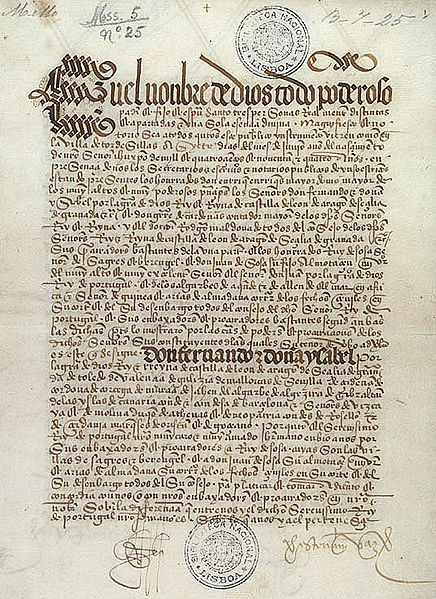
On this date in 1494, the empires of Spain and Portugal signed the Treaty of Tordesillas, which ultimately avoided war by dividing the Americas. This is rarely taught in K-12 history courses. Yet, it is instrumental in explaining the language and cultural divide in Latin America. After teaching about Columbus, the Treaty of Tordesillas offers an excellent starting point for teaching about the colonization of the Americas.

Resource: http://www.gilderlehrman.org/history-by-era/imperial-rivalries/resources/treaty-tordesillas-resolving-%E2%80%9C-certain-controversy%E2%80%9D-over

Resource: http://avalon.law.yale.edu/15th_century/mod001.asp


Sunday, June 2, 2013

Teaching About the Unjust History of Native Peoples and Citizenship


On this date in 1924, President Calvin Coolidge signed the Indian Citizenship Act. This law would finally grant citizenship to all American Indians born within the United States. Indigenous people had been unjustly excluded from the 14th Amendment, which after the Civil War granted citizenship to "all persons born or naturalized in the United States," but infamously excluded "Indians not taxed." Not being citizens meant that Native people lacked the legal protections of others. While the signing of the Indian Citizenship Act was a positive development, it did not reverse the long line of unjust actions by Europeans and later the U.S. government toward the people who first inhabited the continent, most notably the widespread disease and war that swept the continent as a result of Whites, the forced moves during the Trail of Tears, the spread of White settlement through the Homestead Act, the establishment of the reservation system through the Dawes Act, and the Wounded Knee Massacre. However, the the fact that Native people needed to wait over 150 years to be afforded the same legal rights as Whites helps explain the rise of the American Indian Movement in the 1960s and the takeovers of Alcatraz and Wounded Knee in the early 1970s. It is important that U.S. history teachers include the complete story when they teach about the First Nations and offers an opportunity to teach about tribal/national sovereignty and Indigenous self-determination

Saturday, June 1, 2013

Corporate-Back Education Reform Groups and Massachusetts Politics


As a teacher, teacher educator, parent, and resident of Boston, I am concerned that powerful corporate-backed education reform groups and venture-philanthropists are trying to influence both the state legislature and the Boston mayoral race.

In education, Massachusetts is the top performing state in the nation and ranks only behind Singapore internationally on math and science tests. Boston is one of the best urban school districts in the country. It has long been touted as a national model for urban schools. In 2006, Boston won the distinguished Broad Prize for Urban Education as the best city school district in the nation. On the most recent NAEP, Boston 4th and 8th grade students’ gains exceeded the national average for all public schools. Although there is certainly more work to be done, the district has seen amazing educational progress over the past decade and the students, teachers, and parents deserve the accolades. Yet, it is also a district that remains relatively unscathed by market-based reformers. Most students in the district attend traditional public schools, with only 8.7% of Boston students attending a charter school. Only five schools in the entire district are run by outside management groups. There is not a teacher shortage and Teach for America teachers have found placement in only a few schools in the district. It has an active and strong teachers union, all of the district's teachers are in the union, and the teachers are relatively well paid. The vast majority of teachers have gone through university-based teacher preparation programs and hold master's degrees.

Some market-based education reform groups hope to change this. Currently there is a limit to the number of charter schools that can be created in each city or town in Massachusetts. Recently, these groups have begun lobbying the state to eliminate the cap on charter schools and there is currently a bill working its way through the State House that would eliminate the cap on charter schools. What is most egregious about this law is that it only eliminates the cap in the state's 30 lowest performing school districts and would almost exclusively effect the state's urban and rural districts, while shielding the more affluent. In response, the Boston Teachers Union and local parents groups are organizing a press conference and rally against raising the state cap on charter schools this Tuesday. Here is a link to the rally's flyer.

These market-based reform groups have also stated they hope to dramatically reform Boston's and Massachusetts' public schools through the political system, including a recent proposed ballot referendum and the expansion of Teach for America into Boston. With Tom Menino deciding to not run for a sixth term, this is the first time since his election 20 years ago that there will be a competitive mayoral race. These groups have made clear that they intend on supporting and donating to "pro-reform" mayoral candidates (Update: Democrats for Education Reform has officially endorsed John Connolly for mayor). They hope Boston will one day adopt the type of reforms found in Chicago, Philadelphia, L.A., and New Orleans, which focus on increased privatization and decreased teachers union influence. Many of these groups are hosting an educational forum at the Brooke Charter School this Wednesday (6/5) at 7 pm. Consider attending by registering here.

Friday, May 31, 2013

Continuously Uncertain Reform Effort: The Massachusetts History and Social Science Curriculum Framework


Below is a brief background of the Massachusetts History and Social Science Curriculum Framework. It is difficult to locate an up-to-date history of this reform effort and I hope this commentary offers some context for understanding the current state of social studies education in Massachusetts.

The Massachusetts Education Reform Act (MERA) of 1993 had a monumental effect on the public education system in Massachusetts. In less than 20 years, Massachusetts has drastically reformed state oversight of education and embraced the standards-based movement. While Massachusetts has often been touted as a national model of education reform and its students consistently rank at the top of national and international assessments (Massachusetts Department of Education, 2008; Massachusetts Department of Elementary and Secondary Education, 2011), social studies education has taken a back seat to math and literacy in these reforms. Furthermore, over the last decade the state’s history and social science mandate has involved constant mixed-messages related to content, accountability demands, and future existence; conditions which I label a continuously uncertain reform effort.

It has been a turbulent, politically charged, and continuously uncertain road for the Massachusetts History and Social Science Curriculum Framework (Massachusetts Department of Education, 1995, 1997, 2003) and its related graduation test. Over the last 20 years, the state has published three different versions of the history and social science curriculum framework and pilot tested several multiple choice and essay-based exams. Furthermore, the state has delayed the graduation exam requirement on three separate occasions and most recently suspended the social studies assessment indefinitely for budget reasons.

This all began in 1993 when the Massachusetts Supreme Judicial Court ruled that the school finance system in the state violated the education clause of the state’s constitution. As a result, the state legislature passed the Massachusetts Education Reform Act (MERA). This law directed the Commissioner of Education to institute a process for producing curriculum frameworks in the core subjects (mathematics, science and technology, history and social sciences, English, foreign languages, and the arts)” (McDermott et al., 2001, p. 30). MERA also mandated a statewide assessment system based on those curriculum frameworks called the Massachusetts Comprehensive Assessment System (MCAS). According to French (1998), MERA required “broad public participation in the creation of the frameworks” (p. 184). He described the Massachusetts Department of Education (DOE) as embracing this and the DOE openly sought the public’s participation, including teachers and parents. In fact, Massachusetts was the first state to include students in the drafting of their frameworks. As a result of many public hearings and study groups, the DOE created early drafts of the curriculum frameworks, including a draft of a social studies framework called Uncovering Social Studies (Massachusetts Department of Education, 1995). “By the DOE’s estimate, about 50,000 people participated in the process in some way. Educators saw the common core and the curriculum framework as part of a larger project reforming curriculum and pedagogy along constructivist lines, which they supported” (McDermott, 2003, p. 32). The social studies curriculum appeared to have widespread support.

By the mid-1990s, Republican Governor William Weld’s appointments to the Board of Education left a decidedly more conservative view of curriculum and teaching among the board members. In 1996, John Silber was appointed chairperson. “Under Silber, the board revised the curriculum frameworks, eliminating their constructivist tendencies. The educators who had been involved in producing the common core and the frameworks, and in aligning their schools’ curricula with the state requirements, opposed the new direction and criticized the state for changing its goals to suit leaders’ whims” (McDermott, 2003, p. 32). During this political shift in the Board of Education, the social studies curriculum framework also underwent significant changes.

The second generation social studies curriculum framework was created primarily through a top-down process. There is little evidence that the teachers, administrators, students, parents, or historians had much input into their design or creation of the second generation of social studies curriculum. “Teacher committees were dismissed, and new drafts were created by conservative board members and hand-picked practitioners who shared their political viewpoints. In the new social studies drafts, lists of facts about people, places, dates, and events predominated. There was a strong Eurocentric point of view, and key areas of the world were virtually eliminated” (French, 1998, p. 187). The Social Studies Curriculum was renamed the History and Social Science Curriculum Framework and the first officially published version was released in 1997. The new framework’s scope and sequence was ambitious and extensive. The PK-4 curriculum introduced topics of families and communities, early Americans, Massachusetts history, and ancient civilizations. The 5th grade curriculum included U.S. history until 1815, 6th grade was open for electives, 7th grade focused on world history and geography, and 8th grade focused on U.S. history until 1877. The curriculum for high school included world history (from 500 AD to the present) being taught in 9th and 10th grade and U.S. history being taught in 11th or 12th grade. Furthermore, it was recommended that a 12th grade course in civics/US government be taught (Massachusetts Department of Education, 1997). The K-12 curriculum primarily focused on the history of Europeans and White Americans.

Just when it seemed that the social studies curriculum was set in Massachusetts, there was another abrupt change. In 2002, the Massachusetts Board of Education commissioned a new draft of the history/social science framework (Massachusetts Department of Education, 2003). Motivated by the nationalism and patriotism following September 11th, and citing a 1938 Massachusetts law requiring the teaching of American history, the Department of Education abandoned the previous curriculum framework’s emphasis in high school on world history and began work on a predominately United States history focused curriculum (Cohen, 2008). The project was lead by Senior Associate Commissioner Sandra Stotsky and a small group at the Department of Education. This new framework was approved in October 2002 and officially released in 2003 (Massachusetts Department of Education, 2003) with very little input from social studies teachers, teacher educators, history and social science content specialists, or community members. For the past decade, this iteration of the history and social science framework has remained in place.

Once the History and Social Science Curriculum Framework was finally set in 2003, the Board of Education began the process of establishing a high-stakes exam in history that would be required for graduation. This was voted on and approved in October 2006. Students were to meet the “Competency Determination” in U.S. History, beginning with the class of 2012 (Massachusetts Department of Education, 2007). The state established a contract with corporate testing firms to produce the MCAS History and Social Science pilot exam based on the 2003 History and Social Science Framework. Cohen (2008) explained that WestEd of California created the exam as a subcontractor for Measured Progress of New Hampshire. Furthermore, he found, “the Department of Education, in order to broaden the input of educators, has set up teams of teachers to serve on Assessment Development Committees (ADCs) at each of the levels of testing … before the examinations are printed, to go over the questions presented by WestEd and Measured Progress in order to make sure that the questions are significant, rather than trivial. Representatives of both companies attend as well” (p. 3). However, this self-selected group did not necessarily represent an accurate cross-section of the state’s social studies teachers, as this was a major time commitment and many teachers were unable to participate. Multiple choice and essay-based pilot exams were administered to grades 5, 8, and 10 between 2005-2008. The 5th grade exam focused on North American Geography and U.S. history until 1820. The 7th grade test included questions on world geography and ancient civilizations. The 10th grade test primarily focused on U.S. history. The 5th and 10th grade exams also included questions on government, civics, and economics (Massachusetts Department of Education, 2007). Many of the teachers that administered these tests, including myself, found them to be sub-par.

At first, the state gave districts very little access to their students’ data from these pilot exams. However, in the later years, access was given to overall school-wide performance, but not the scores of individual students. In 2009, the history/social science pilot exams were unexpectedly and abruptly suspended as a result of budgetary issues. At the same time, it was announced the graduation requirement would be delayed for the third time in the last half decade to the class of 2014 (Massachusetts Department of Elementary and Secondary Education, 2009). The latest development occurred in 2011, when the Board of Elementary and Secondary Education voted to delay the history and social science requirement until three consecutive history and social science assessments are administered statewide. Since the state has yet to administer a single history and social science assessment, it is unlikely teachers will see the subject required for graduation anytime soon. However, the state does continue to send the mixed message that the test is still in development, while simultaneously remaining suspended. To the detriment of Massachusetts students, the social studies curriculum framework and assessment continues to be a continuously uncertain reform effort.

References

Cohen, S. (2008). What form should the test take? Disagreements over assessment in Massachusetts. Statement on State History Assessments. Retrieved March 20, 2011, from http://www.nationalhistorycenter.org/statementhistoryassessments/

French, D. (1998). The state's role in shaping a progressive vision of public education. Phi Delta Kappan, 184(1), 184-190.

Massachusetts Department of Education. (1995). Uncovering social studies: Draft social studies curriculum. Malden, MA: Author.

 Massachusetts Department of Education. (1997). History and social science curriculum framework. Malden, MA: Author.

Massachusetts Department of Education. (2003). History and social science curriculum framework. Malden, MA: Author.

Massachusetts Department of Education. (2007). MCAS guide to history and social science assessments. Malden, MA: Author.

Massachusetts Department of Elementary and Secondary Education (2009). Education board votes to postpone history graduation requirement. Retrieved March 10, 2009, from http://www.doe.mass.edu/news/news.aspx?id=4597

McDermott, K. A. (2003). Capacity to implement education reform. Education Connection, 31-33.

McDermott, K. A., Berger, J. B., Bowles, S., Brooks, C. C., Churchill, A. M., & Effrat, A. (2001). An analysis of state capacity to implement the Massachusetts Education Reform Act of 1993. Amherst, MA: University of Massachusetts Center for Education Policy